
The article Method Matters: A Comparative Evaluation of Tissue-Derived Extracellular Vesicle Isolation Methods in Non-Small Cell Lung Cancer, describing research carried out by the International Centre for Cancer Vaccine Science (ICCVS) at the University of Gdańsk, has been published in ‘Cell Communication and Signaling’ – an international scientific journal with a high impact factor, dedicated to research into intercellular communication and its role in health and disease.
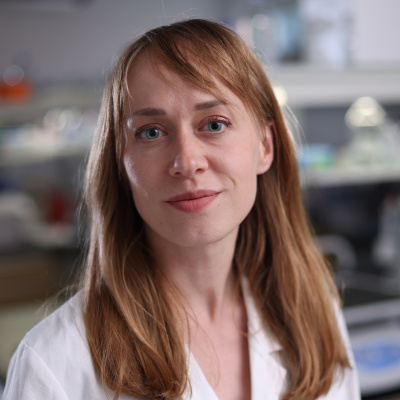
Dr Anna Biernacka
‘To understand how cancer cells communicate with the immune system, we must first understand the tiny vesicles they release,’ says dr Anna Biernacka, the paper’s first author.
Prof. Natalia Marek-Trzonkowska, head of the SWIFT project, discusses these tiny structures released by cancer cells and the related research being carried out by the ICCVS UG team:
‘Cancer cells release tiny structures known as small extracellular vesicles (sEVs). These vesicles enter the body’s bodily fluids (including blood, lymph, saliva, tears, urine and synovial fluid) and spread throughout the body. The tumour packs specific contents into them, designed, for example, to prepare a suitable environment for the growth of metastases and to suppress the immune system’s anti-tumour response. For this reason, one of the main areas of research being conducted as part of the SWIFT (Science for Welfare Innovations and Forceful Therapies) project, carried out by the International Centre for Cancer and Vaccine Research, is precisely to gain a thorough understanding of the biology of the vesicles produced by the tumour and to protect the immune system from their harmful effects. The publication in “Cell Communication and Signaling” summarises the initial stage of this research.’
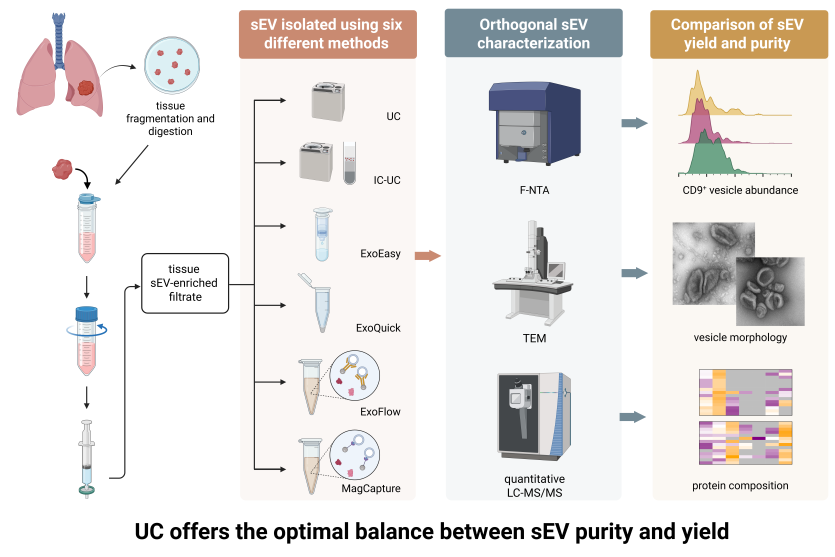
The ICCVS team is investigating how these tiny vesicles interact with immune system cells and whether this communication can be blocked. To do this, sEVs must first be isolated directly from samples of tumour tissue and healthy lung tissue taken from patients with non-small cell lung cancer (NSCLC). However, this is no easy task – the tissue samples contain many other particles and structures of similar size, which are difficult to distinguish from sEVs and separate from them.
‘Before determining how these vesicles affect immune system cells, we had to answer a more fundamental question: how sEVs can be effectively isolated directly from lung tissue,’ explains dr Anna Biernacka. ‘In our study, we compared six different methods for isolating extracellular vesicles to determine which one works best for lung tissue samples. We assessed the resulting material in various respects – checking, amongst other things, the number of particles obtained, their size and their protein profile. The results showed that ultracentrifugation ensures both high purity of the material obtained and the best efficiency in isolating vesicles.’
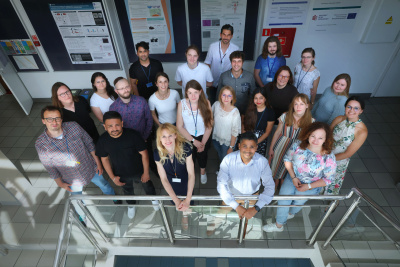
ICCVS UG Team
These results represent an important first step towards developing a method to protect immune system cells from the negative effects of tumour-released vesicles. The isolation of sEVs from tissues remains a significant technological challenge. For this reason, the detailed protocol developed for the extraction of vesicles from tumour tissue will also be useful for other research teams working on the isolation of sEVs from tissues. The choice of an appropriate isolation method, and consequently the acquisition of a sufficient quantity of pure material, is of paramount importance for obtaining reliable and comparable research results.
The authors of the publication Method Matters: A Comparative Evaluation of Tissue-Derived Extracellular Vesicle Isolation Methods in Non-Small Cell Lung Cancer are:
Anna Biernacka, Jakub Faktor, Martyna Siewiera, Ines Papak, Artur Piróg, Zuzanna Urban-Wójciuk, Magdalena Sitkiewicz, Magdalena Szczepanowska, Tomasz Marjański, Witold Rzyman, Aneta Zebrowska, Monika Pietrowska, Danuta Gutowska-Owsiak, Sachin Kote and Natalia M. Marek Trzonkowska.
This work is the result of collaboration between the International Centre for Cancer Vaccine Science (ICCVS) at the University of Gdańsk and:
- the Department and Clinic of Thoracic Surgery at the Medical University of Gdańsk
- the Department of Family Medicine at the Medical University of Gdańsk
- the Experimental and Translational Immunology Laboratory of the Intercollegiate Faculty of Biotechnology UG and MUG
- the Department of Biotechnology and Nutrigenomics at the Institute of Animal Genetics and Biotechnology of the Polish Academy of Sciences in Jastrzębiec
- the Maria Skłodowska-Curie National Institute of Oncology in Gliwice
- the Department and Unit of Histology and Cell Pathology at the Medical University of Silesia in Katowice
The SWIFT project is funded under the International Research Agendas (MAB) programme of the FPS, with funding from the European Funds for a Modern Economy 2021–2027 (FENG) programme, FENG Priority FENG.02: An Environment Conducive to Innovation, Measure FENG.02.01: International Research Agendas.
Full text of the publication:
