
The University of Gdańsk is hosting two participants in the KRASP and Elsevier scholarship programme. Dr Halyna Alekseievska and dr Vadym Chepizhenko - researchers from Ilya Mechnikov Odessa National University - told us about the aims and challenges of conducting research, as well as their impressions of their stay at the University of Gdańsk. One of the projects concerns the participation of the English nobility in the so-called Northern Crusades. We spoke about it with dr Vadym Chepizhenko.
The aim of the scholarship programme organised by the Conference of Rectors of Academic Schools in Poland (KRASP) in cooperation with Elsevier is to strengthen the research potential of Ukrainian doctoral students and researchers. The programme enables them to undertake a research internship in Poland, during which they can carry out their own research projects and make use of the resources of selected academic centres.
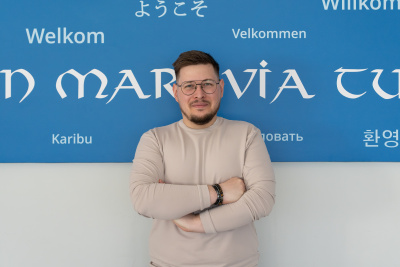
Dr Vadym Chepizhenko works at the Department of Archaeology, Ethnology and World History at Ilya Mechnikov Odessa National University. He also heads the Centre for Ancient and Medieval Studies. As a researcher, he is interested in the social and cultural history of the Middle Ages, the history of elites, medieval genealogy and heraldry, political iconology and the history of ideas. His current research focuses on the prosopography of the English nobility between 1327 and 1413.
As part of a KRASP and Elsevier scholarship, dr Vadym Chepizhenko is undertaking a research placement at the Faculty of History, University of Gdańsk, under the supervision of prof. dr hab. Beata Możejko. He is carrying out a research project entitled ‘English Nobility in the Northern Crusades’, the aim of which is to determine the scope, motives and forms of the English nobility’s participation in the Northern Crusades.
Interview with Vadym Chepizhenko
Karolina Żuk-Wieczorkiewicz: - Your research interests focus on Middle Ages, including medieval England, and the history of elites. How did you get interested in it? What is fascinating about the topic?
Dr Vadym Chepizhenko: - My interest in the Middle Ages emerged already during my school years, when I was fascinated by reading historical novels and fantasy literature such as Maurice Druon’s Les Rois maudits and J. R. R. Tolkien’s The Lord of the Rings which played an important role in shaping my early fascination with the medieval world.
During my university studies, I came to realize how dynamic and structurally complex the medieval period actually was, contrary to the widespread stereotype of its supposed “stagnation”. Medieval England attracted me as a kind of historical “laboratory” of social and political processes: it was here that effective institutional mechanisms of power, interaction between monarchy and aristocracy, and legal regulation of elite status developed at a remarkably early stage.
The history of elites interests me primarily as a key to understanding how decisions were made, political cultures were formed, and social hierarchies were constructed. The English nobility in the Middle Ages existed in a constant field of tension between royal authority, local interests, and transnational connections, which offers rich opportunities for analyzing identities, strategies of self-representation, and mechanisms of power legitimation.
Medieval society allows one to trace how personal ambitions, family strategies, and institutional frameworks interacted with one another, shaping long-lasting patterns of European elite culture.
- You planned to conduct historical research on English nobility in the Northern Crusades. How much of your research plan did you manage to carry out so far?
- To date, I have been able to implement a significant and conceptually important part of the planned research project, primarily its preparatory, analytical, and methodological stages. During my stay at the University of Gdańsk, I focused on establishing a solid source-based and historiographical foundation for the study, without which further interpretation of the material would not have been possible.
First and foremost, I conducted a systematic analysis of key narrative and documentary sources related to the involvement of English knighthood in the activities of the Teutonic Order in Prussia, including order chronicles, diplomatic correspondence, and charter material. An important stage of this work was archival research carried out at the State Archives in Toruń and the State Archives in Gdańsk.
In parallel, I worked extensively with modern Polish-, German-, and English-language historiography using the holdings of the University of Gdańsk Library and the Gdańsk Library, which made it possible to integrate the English material more effectively into the Baltic and broader European context.
A key outcome of this stage was the compilation of a preliminary prosopographical database of English participants in the Northern Crusades, recording their social origins, forms of participation, chronology, and travel routes. I deliberately linked this work with my previous research on the English nobility of the fourteenth and early fifteenth centuries, which made it possible to connect the “crusading experience” with broader elite strategies of prestige, service, and political career-building.
In addition, I made substantial progress in the conceptual development of the project: I refined the research questions, deepened the comparative perspective between the participation of the English nobility in crusades in the Baltic region and in the Middle East, and outlined an interdisciplinary framework combining approaches from political, social, and cultural history.
At the same time, the final publication of the research results remains a task for the next stage of the project. Thus, now, it is possible to speak of the successful completion of the preparatory and analytical core of the study, which has created a strong foundation for completing prosopographical analysis and preparing scholarly publications.
- What do you like in your stay and scholarship at the University of Gdansk?
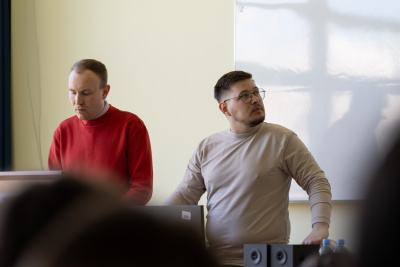
- First and foremost, I greatly appreciate the high academic standards and the welcoming intellectual atmosphere of the University of Gdańsk. My stay here provided the opportunity to work in an environment of specialists for whom the history of the Middle Ages and the Baltic region has been the subject of long-term, systematic research. Scholarly discussions and informal consultations have significantly contributed to refining my research approaches and broadening my comparative perspective.
An important aspect is also the practical framework of the scholarship, which allows one to focus fully on academic work. Access to library collections, archives, and museum holdings in the Tricity area creates optimal conditions for source-based research, while the scholarship programme itself provides the necessary stability and academic freedom to carry out a complex, multi-component research project.
Finally, Gdańsk itself, as a historic city, is an exceptionally inspiring setting for a medievalist. The combination of a rich historical heritage, well-organized academic infrastructure, and a vibrant scholarly life make my stay at the University of Gdańsk not only productive but also a truly valuable experience of professional growth.
- What are greater challenges during your scholarship?
- The main challenges during my scholarship period primarily relate to the intensity of the research work and the need to use the limited research time as efficiently as possible. Combining the study of complex historiography, source-based research, and active participation in the academic life of the university requires a high level of self-organization and careful prioritization of tasks, especially within such an intellectually dynamic environment.
Another challenge is adapting to a new academic and linguistic context. Although English serves as the main language of scholarly communication, working within a Polish academic environment involves gradual familiarization with local academic traditions, scholarly culture, and, to some extent, the Polish language - particularly in library and archival research. At the same time, I view this not only as a difficulty but also as an important component of professional development.
An additional challenge arises from working with sources that are often fragmentary, difficult to interpret, and require an interdisciplinary approach. This necessitates constant methodological reflection and consultation with colleagues, which, however, ultimately makes the research process deeper and more productive.
Overall, I regard these challenges as an inherent part of academic mobility and scholarly growth. It is precisely through addressing them that the research stay becomes not merely a working stage, but an important experience of professional and personal development.
- In your research here, was there something that especially impressed you or surprised you?
- Yes, during my research at the University of Gdańsk there were several aspects that genuinely impressed me. First and foremost was the extent to which the participation of the English nobility in the Northern Crusades was embedded in broader European political, diplomatic, and cultural networks. Working with Baltic sources and historiography made it clear that these crusades were not perceived by contemporaries as peripheral or episodic events, but rather as an important form of chivalric activity and a means of demonstrating prestige.
What particularly surprised me was how well documented the involvement of individual members of the English elite proved to be - both well-known figures and those who have received much less scholarly attention - in the campaigns of the Teutonic Order. This opens far broader possibilities for prosopographical analysis than initially anticipated and allows for a more precise reconstruction of individual travel routes, motivations, and social strategies.
Another significant insight was the role of cultural and symbolic factors - such as the chivalric code, the idea of pilgrimage, and contemporary notions of “just war” - in shaping decisions by English nobles to participate specifically in the Baltic crusades. In this respect, the Baltic material has proven especially productive for comparison with crusading movements in the Middle East.
Overall, my research in Gdańsk not only confirmed my initial hypotheses but also substantially expanded my perspective on the topic, prompting a re-evaluation of the place of the Northern Crusades in the political and cultural history of the late medieval English elite.
- What is your greater hope (or goal) connected with your stay at the University of Gdansk?
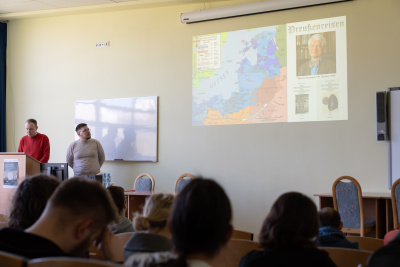
- My main goal associated with my stay at the University of Gdańsk is to significantly advance research on the English nobility in the context of the Northern Crusades and to fully integrate it into a broader Baltic and European scholarly discourse. I see this research stay not merely as a period of data collection, but as an opportunity to develop a conceptually mature study based on the combination of English and Central European historiographical perspectives.
Equally important to me is the hope of establishing lasting academic contacts with scholars working on the history of the Teutonic Order, medieval Poland, and the Baltic region. Such collaboration not only contributes to the refinement of my own methodological approaches, but also creates a foundation for future joint projects, publications, and international research initiatives.
In the longer term, I hope that the results obtained during my stay at the University of Gdańsk will form the basis for scholarly publications and for the development of a larger prosopographical project devoted to the transnational mobility of medieval elites. In this sense, my greatest hope is that this research stay will not be a self-contained episode, but an important step in shaping a sustainable, internationally oriented research trajectory.
- Would you recommend our University to other researchers, including PhD students? Why?
- Yes, without any doubt, I would recommend the University of Gdańsk to other scholars, and especially to doctoral students. The university combines a high academic standard, a well-developed research infrastructure, and an open, supportive scholarly atmosphere, which is particularly important at the early and intermediate stages of an academic career.
Access to specialized library collections, archives, and museum holdings in the Tricity area provides exceptional opportunities for in-depth source-based research. These resources are especially valuable for historians working with medieval materials and transregional perspectives.
Equally important is the university’s approach to doctoral candidates and early career researchers as full members of the academic community. The opportunity to participate in seminars, colloquia, and informal scholarly discussions fosters professional growth, methodological maturity, and the development of international academic networks.
It is precisely the combination of academic rigor, high standards, and genuine support that makes the University of Gdańsk an attractive and productive environment for researchers who aim to develop their projects within a broader European and international context.
I would also like to express my sincere and special gratitude to prof. Beata Możejko and mgr Kacper Panek, whose support and personal engagement were of crucial importance for the successful completion of my research stay. Professor Beata Możejko created highly favorable conditions for scholarly work, offered valuable advice on the interpretation of source materials, and generously shared her expertise as a specialist in the medieval history of the Baltic region. At the same time, I am deeply grateful to Kacper Panek for his practical assistance, organizational support, and constant readiness to help resolve a wide range of academic and everyday matters. Their openness, professionalism, and friendliness contributed significantly not only to the smooth course of my stay at the University of Gdańsk, but also to my broader professional and academic development.