
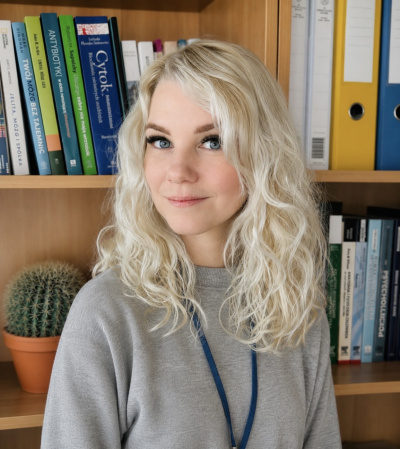
How can scientific development be combined with addressing real social needs? A good example is the project led by dr hab. Karolina Pierzynowska, prof. UG, entitled ‘Development of a comprehensive care system for NBIA (neurodegenerative disease with iron deposition in the brain) patients in Poland’. The project has received funding under the Ministry of Science and Higher Education’s ‘Science for Social Development’ programme. The value of the funding awarded is over PLN 1.97 million.
The project, led by dr hab. Karolina Pierzynowska, prof. UG, focuses on the rare neurodegenerative disease NBIA and combines molecular research into new therapies with initiatives aimed at improving the quality of life for patients and their families. The project will involve scientific, psychological, social and educational activities related to the care of people with NBIA.
Project challenges
‘One of the project’s greatest challenges is combining scientific research into a very rare neurodegenerative disease with tangible support for patients and their families,’ says prof. Karolina Pierzynowska. ‘NBIA is a group of severe, progressive diseases for which there is currently no effective causal treatment. Although these are rare diseases, the number of patients in Poland is significant, and families very often lack adequate systemic support and access to specialist knowledge and care. Another major challenge is to create a care model that can function in the long term and be implemented more widely across Poland.’
As prof. Karolina Pierzynowska notes, research into NBIA requires close collaboration between specialists from many fields - medical biologists, psychologists, educators and social experts - to develop solutions that address both medical needs and the everyday challenges faced by families. Therefore, the project will be carried out by three units of the University of Gdańsk: the Faculty of Biology, the Institute of Psychology and the Institute of Education, with the support of the NBIA Poland Association, which has been supporting patients and their carers for years.
The significance of the grant
‘I hope that the project will contribute to improving the quality of life for NBIA patients and their families, and will raise public awareness of rare diseases. We aim to combine comprehensive care for families with molecular research into the mechanisms of the disease and potential therapies. We have planned a wide range of activities, both scientific (conducting research, organising an international conference with specialists from across Europe) and social (surveys on families’ needs and psychological support, piloting a family care coordinator model for NBIA), and educational (meetings with families, training for healthcare professionals, publication of a monograph, a public awareness campaign, and improving families’ access to information and specialist support). This project has the potential to make a real difference to the lives of NBIA patients and their families,’ sums up prof. Karolina Pierzynowska.
About the programme
The ‘Science for Social Development’ programme, established by the Ministry of Science and Higher Education, supports higher education and research institutions working to promote science in the following areas: conducting research with application potential, building cooperation between science and the socio-economic environment, and the implementation of solutions serving the community (from the national to local communities).
In the second round of the call for proposals, the Ministry of Science and Higher Education awarded funding to 37 projects, including one from the University of Gdańsk.