

Can music therapy support addiction treatment? An international team of researchers involved in the FALCO project (Fighting addictions, improving lives: Comprehensive drug rehabilitation with music) is seeking answers to this question, particularly in the context of the long-term effects of such support. In Poland, the project is being carried out by the University of Gdańsk and the Provincial Addiction Treatment Centre in Gdańsk. At the end of May - as part of the project’s activities - a public science event entitled ‘From sound to health - music instead of addiction’ was held at the Faculty of Social Sciences, aimed at school pupils and people in the midst of an addiction crisis.
We discussed the therapeutic potential of music therapy in the context of addiction treatment with dr hab. Łucja Bieleninik, prof. UG (head of the FALCO project in Poland), dr Marcin Szulc, prof. UG (specialist in adolescent psychology and the prevention of social risks), and mgr Daria Makurat (research assistant and PhD student at the Doctoral School of the Faculty of Social Sciences, University of Gdańsk).
Karolina Żuk-Wieczorkiewicz: - What types of addiction do young people most commonly face today? Has anything changed over the last few years?
Prof. Marcin Szulc: - Things have changed, of course. First and foremost, we need to distinguish between substance-related and non-substance-related addictions. Today, non-substance-related addictions dominate, although we still lack proper diagnostic tools here, as addiction to smartphones or computer games has not been officially recognised in the latest diagnostic classifications.
I would rather speak of the dysfunctional use of these activities. Without a doubt, the number one form of non-substance-related abuse is social media and various apps - take TikTok, for example, which is designed to be highly addictive. This app induces a constant craving to compulsively scroll through videos. Why is it addictive? Because the rewards are irregular.
An interesting video is followed by a boring one, a boring one by a funny one, and a funny one by another less engaging one. These are perfect situations for conditioning. On top of that, TikTok is performative and encourages the imitation of activities that aren’t necessarily wise. In any case, adults also struggle with overuse and spend half the day watching clips. And some try to follow recipes, which sometimes ends in a kitchen disaster, a waste of time, and the surprise: ‘How come? It looked quicker in the video.’
- And what are the most common forms of substance addiction?
MS: - Among substance-related forms of addiction or abuse, e-cigarettes and vaping are currently in first place. Polish schoolchildren top the European rankings for e-cigarette use among young people. I get the impression that in this area, we have practically surrendered to the tobacco companies. We have drug addiction prevention programmes, we have alcohol addiction prevention programmes - and virtually nothing when it comes to vaping and the use of e-cigarettes.
- So, is an e-cigarette safer or more dangerous than a traditional cigarette?
MS: - I’ll answer like a typical psychologist: it depends. If we compare a single use of a traditional cigarette with a single use of an e-cigarette, the e-cigarette does indeed seem to come out better, as it doesn’t contain nearly as many toxic compounds. However, the issue is the scale of the phenomenon, which is a scourge in Poland. After smoking a traditional cigarette (though I’d like to stress that this isn’t an endorsement of traditional cigarettes), you throw it into an ashtray. With e-cigarettes, there’s no limit to their use. Young people vape in lessons, during breaks, and in prohibited areas, because no one is able to control it.
It is also worth noting that different substances are predominant among different age groups. At a younger age, i.e. 12, 13, 14 years old, e-cigarettes predominate, but then alcohol comes into the picture, which is used very actively between the ages of approximately 16 and 40. In Poland, we have 800,000 people registered as addicted to this substance. Unofficially, it is said that the actual number of addicts is four times higher.
Of course, cannabis is also a scourge; it is probably one of the most fetishised drugs in the world. Together with Dr Robert Rejniak, we once analysed films in which this substance appears. We noticed a certain pattern: films featuring cannabis are most often comedies. And in pop culture?
‘It came to me, I don’t know from where, it turned my head so completely.’ Andzia? No, no. In the original version it was ‘gandzia’ [ed. note: reference to the popular Polish song; Andzia is a nickname for Anne, whereas gandzia is slang for marijuana]. This is a drug that is ‘marketed’ in the media and pop culture as ‘chill-out’, as something that helps you relax. However, it is important to remember that the people who produce drugs are not nice blokes who go to work at 7:00 on a Monday morning thinking about how to make someone’s weekend more enjoyable. These are people who want to make money, and they are not subject to any regulations. As a result, after consuming cannabis, instead of the expected ‘chill-out’, someone may, for example, experience strong stimulation or dizziness. So-called ‘concentrated pockets’ pose a major risk. We never know the distribution of the psychoactive substance within the plant material.
However, the most dangerous drugs in the world are those in the opioid group. They can lead to circulatory and respiratory failure, and consequently to death. In Europe, around 5,500 people die each year from opioid overdoses, accounting for 74% of all deaths from overdoses of various substances.
- What can we do, for example as parents, to minimise the risk of addiction among young people?
MS: - The key factor in protecting our children from various dangers is building close, strong relationships with them based on trust and respect. The closer we are to our children, the further away we are from trouble. The eminent Danish family therapist Jasper Jull believed that in a relationship between two adults, both are equally responsible for it because they have mature brains. In a relationship between an adult and a child, the adult alone is responsible for its quality. Our influence as parents diminishes after the age of 12, because during this period, it becomes crucial for our children to build close relationships with their peers, which is also in line with developmental norms.
It is worth remembering that addictions are one of the most democratic illnesses in the world, as they can affect literally anyone. We can also view them from two perspectives: medical and non-medical. In the medical approach, addiction is an illness. However, we, as psychologists, also have a different perspective.
It is probably difficult to find people who, reaching for a drink, would say: ‘My goal is addiction’. That is why we more often adopt a non-medical stance, arguing that addiction is not a disease, but a symptom of a disease. A disease of the soul.
Dr hab. Łucja Bieleninik, prof. UG: - That is why psychotherapy is so important in rehabilitation.
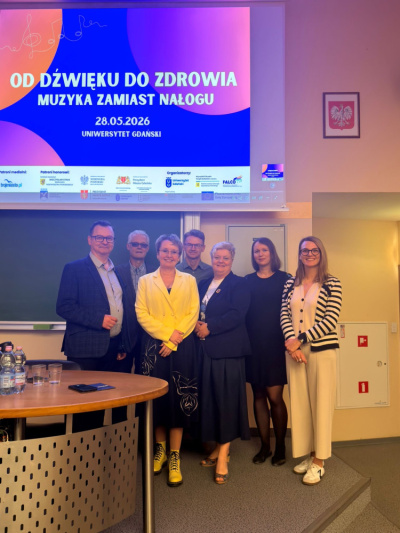
- Where did the idea for the conference ‘From sound to health - music instead of addiction’ come from?
ŁB: - The idea for the conference ‘From Sound to Health - Music Instead of Addiction’ arose from the need to combine current scientific knowledge on addiction with modern and more engaging forms of prevention. We were also inspired by the international FALCO project, run by the University of Gdańsk, which aims to investigate how music can support the recovery process of people with substance use disorders. The event was educational and preventative in nature. We wanted to show young people, teachers, specialists and those in the midst of an addiction crisis that talking about addiction need not be limited solely to warnings and statistics.
- Music therapy is not something that immediately springs to mind as a primary method of addiction treatment. Have there been any studies examining its effectiveness in this area?
ŁB: - Music therapy can primarily support treatment as part of a comprehensive treatment programme. It is not a standalone method of ‘addiction treatment’, but a valuable complement to various forms of psychotherapy, psychiatric support or rehabilitation activities. Meta-analyses, systematic reviews of randomised clinical trials and neuroscience research indicate that music therapy can be an effective strategy to support the addiction treatment process.
- How?
ŁB: - Music therapy minimises cravings, increases motivation to change, but also contributes to better short-term outcomes in terms of - for example - mental health, the risk of depression, and the reduction of anxiety and stress. Different forms of music therapy can yield different results. Effectiveness depends on many factors, such as: the type of substance addiction, the patients’ age, the stage of therapy, individual preferences or experiences related to music, and the method of conducting therapeutic interventions. The FALCO project aims precisely to help us better understand which forms of music therapy will be - on the one hand - most effective, and on the other hand - in which patient groups they may bring the greatest benefits.
- Could you tell us more about how music therapy is used in the context of addiction treatment?
Daria Makurat: - Music therapy can be used in both active and receptive forms - and it is the effects of these approaches that we are investigating in the FALCO project.
Active music therapy includes, for example, songwriting, vocal improvisation, instrumental improvisation, but also, for instance, making music together with a therapeutic group. These are activities that help participants express their emotions and develop their creativity, whilst also strengthening their sense of control and practising social skills within the group.
One interesting technique is songwriting, where participants work with a music therapist to create songs that relate to their daily lives, experiences, motivation for change, or, for example, their sense of sobriety.
In contrast, receptive music therapy focuses more on listening to music and subsequent reflection on it. This type of music therapy may involve analysing song lyrics, as well as analysing sounds, the melodic line in songs, and the significance of music in life. Participants, together with the music therapist, analyse the emotions that the music they have listened to has evoked in them; they observe their bodies and check how they react to specific music, for example, whether any tension has arisen. They also create their own playlists, which can help them during difficult times in life.
- Is it about people with addictions learning to cope through music?
DM: - Yes. Music can also act as a signal or a trigger regarding substance use. That is why, during the sessions, participants learn to recognise how music affects them and what emotions it evokes.
- Referring to the conference theme - does music really have the power to replace addiction?
ŁB: - Music in itself certainly cannot replace therapy or addiction treatment, but it can become a very important tool supporting the recovery process. Music is present in all cultures around the world and is one of the most natural and universal sources of pleasure. Music (much like psychoactive substances) affects, amongst other things, the brain’s dopaminergic reward system - but without the negative consequences. Music can reduce tension and stress, alleviate anxiety, improve mood, foster a sense of community, and provide positive emotional experiences - without the need to resort to psychoactive substances. This is particularly important when working with young people. Music is a natural part of their everyday lives and a means of self-expression. As such, it can be an effective preventive tool in fostering healthy forms of activity and social relationships, which are of paramount importance for adolescents.
MS: - Professor, you made a very important point: that music can be a factor in supporting or diverting young people from various unconstructive forms of behaviour. However, this factor must always be considered within a broader context.
I know many people who have partly lost themselves in their passion for music, and the environment in which they lived also pushed them towards drugs. There are many examples of musicians who lost their lives due to the use of psychoactive substances, such as Elvis Presley, Amy Winehouse, Bon Scott, Layne Staley, Jimi Hendrix and Ryszard Riedel.
Music (or making music) is therefore certainly an element that can steer one away from harm, but without these additional environmental factors, it need not necessarily be such a protective factor.
- I understand that it is a tool we can use in various ways?
DM: - First and foremost, music (making music, listening to music) has relaxing, calming or stimulating effects - depending on our needs at any given moment. Such applications of music therapy have been confirmed by numerous studies as a form of support for the recovery process of people with addictions.
- What were your hopes for the conference? The programme included both specialist lectures and practical exercises, and the participants were not only ‘ordinary’ school pupils but also people currently undergoing therapy.
MS: - Preventive lectures may not be the ideal form of prevention, because prevention is, above all, evidence-based. It involves long hours of workshops, working with young people on shaping their future, what might pose a threat to it and what might be beneficial for their development. Nevertheless, a good lecture, if delivered properly, with a good dose of energy and a sense of humour, can be a beneficial factor in prevention. The University of Gdańsk is a socially responsible institution, and our work is part of that responsibility: we invite young people to attend reliable, accessible academic lectures on the harmful effects of substance use.
ŁB: - First and foremost, participants received a wealth of reliable, up-to-date knowledge presented in an accessible and engaging manner. Lectures by experts from the University of Gdańsk (Dr Wojciech Glac and Dr Marcin Szulc, Professor at the University of Gdańsk) provided a better understanding of both the health consequences of addiction and the mechanisms by which music affects the human brain. The workshops were also a major highlight of the event: music therapy sessions, as well as psychological workshops designed to strengthen social skills, regulate emotions and promote relaxation.
We aimed them at both students and people struggling with addiction. We wanted young people not only to gain knowledge, but also to experience how music can support emotions, relationships and mental wellbeing.
I feel that this event helped to break down certain stereotypes regarding addiction therapy and showed that effective prevention today requires modern, interactive, interdisciplinary and personalised approaches. It should be directed at people who genuinely need knowledge and practical support in this area.
- What are the key differences between preventive work and working with someone who is already in the midst of an addiction crisis? I am thinking primarily of the use of music therapy.
DM: - I think the goal set at the start of the work is crucial. In the case of prevention, music therapy is primarily preventative and developmental in nature. Its aim is, for example, to support coping with stress in everyday life and with the tensions that arise, to strengthen self-esteem, or to develop personal resources and social relationships. Preventive activities are often linked to opportunities for shared expression or integration.
In addiction therapy, music takes on a more structured role. It is woven into the therapeutic process and focused on achieving specific goals, such as reducing cravings for substances. Therapeutic goals are set by the therapist in collaboration with the group, taking into account the individual needs of the participants. This process is based on a previously agreed therapeutic contract, which sets out the framework and principles for conducting the therapy.
- What are your hopes for the future regarding the conference - and research into music therapy within the FALCO project?
ŁB: - The FALCO project aims to demonstrate not only whether music therapy - and which forms of it - are effective for people with addictions, but also how music therapy can influence the recovery process. The project combines clinical psychology and health psychology with neuroscience to better understand the mechanisms of music therapy as a non-pharmacological method supporting addiction rehabilitation. The project concludes in December 2029. We plan to present the results to a wider audience at that time, including decision-makers, stakeholders and the general public. We hope that the scientific meeting we organised has served as a good starting point for further activities aimed at disseminating the project’s findings and their practical application.
- So you’re simply doing science…
MS: - You can’t do good science without a sound theory. However, the key issue for the average person grappling with various problems is how that theory can be translated into practice.
Today, we are facing a huge scourge of anti-science across the globe. Its destructive and demoralising potential can be enormous.
That is why it is very important for us to strictly adhere to research methodology and to communicate the results in accessible language - so as not to lose public trust. We can achieve this by giving people something they need, which safeguards their health and, not infrequently, their lives.
ŁB: - That is why we work within the framework of evidence-based practice. We conduct socially responsible research that is intended to be applied in practice.
- Thank you for the interview!