
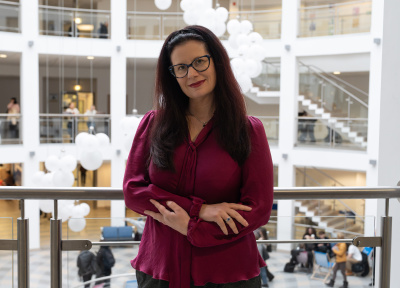
Can games truly change a person? How can they be used in shaping positive values? Professor Sarah L. Bowman, who visited the University of Gdańsk as part of the Visiting Professors programme, explains that it’s not just a game itself that matters. What do we need if we want to use role-playing games as a teaching method?
Karolina Żuk-Wieczorkiewicz: - If you think about role playing games, do you consider them more passion and a hobby or a field of scientific research? How did you get interested in role-playing games as a method of teaching?
Prof. Sarah Bowman: - It's a little bit of both. I started out as a role player at like 16 years old, and so of course, I never thought at that point I would ever be researching it. Then, you know, as I grew up, I started to do studies here and there until I wrote my dissertation. And then, it was an area that wasn't very explored at the time, and so we decided - my supervisor and I - to go in that direction.
Now I would say it goes back and forth. I don't have a whole lot of time to play, so I spend a lot of time researching. But I'm trying to make sure there's more play in my life so that I can remember what's special about it but also have new insights.
- It seems to me a necessary skill to know what you are talking about when you implement games as a part of teaching. Does this experience help you?
- Being a gamer, oh, absolutely. Quite frankly, I don't think it's a good idea to be a game scholar but not to play games. I think people should experience playing because it is something that is embodied, it’s not something that you can just read from a book and understand it. But I'm also very focused on the phenomenology of plays, specifically what's going on in the human mind and between humans - and the interactions between humans. That's something very hard to access if you're not in some way familiar with the states that you're studying.
- During your lecture, I got the impression that role-playing games can be a double-edged sword: they can have both positive and negative effects. For example, in classical D&D [Dungeons and Dragons] there’s a lot of violence and some choices that players make may seem controversial. On the other hand, certain game designs or campaign design may result in shaping positive values such as empathy. Referring to your experience so far, how can these values be developed by playing games? How does it work?
- That's a good question. I think the community surrounding the game makes a big difference. We learn by being embedded in social networks. In some larp [life action role playing - ed. note] communities the environment around the game is incentivizing competitiveness or even some sort of authoritarian values. It's not extremely common, but it may occur, particularly in areas where there's a strong focus on combat, structure and hierarchy.
I think that it's really important to have a value of inclusiveness in the community and an emphasis on psychological safety, as well as communication to the players that they are more important than the game. That sort of inclusive value system is not necessarily what people are playing out in the game - sometimes they can play quite the opposite - but it is important that the community is reinforcing those ‘good’ values and norms.
- So, first the player, then the game?
- Yes, exactly.
- Can game somehow change a person or change the way the person thinks or feels? What can you say as a researcher and as an academic teacher?
- I don't think that games themselves change people. I think that games provide an environment where change is possible to happen and where change can be catalysed by specific techniques, specific structures or incentives, but it's not guaranteed and it's not the game that's doing it. It's more like a stimulus and something we call a container - a space of containment within which a process can take place.
For example, when I talk to therapists who use Dungeons and Dragons in their work with adolescents, they say that they can get more done in a month or three of Dungeons and Dragons therapy than they can in a year of talk therapy. It’s because there's something about the creativity and the fiction and the co-creation - and the fun. It's not always fun in the classical sense, but it allows people to lower their vigilance. So maybe they're not thinking about their own issues. They're just experiencing their character.
- Talking about the process: you said that when implementing a game as a teaching method, there's not just a game but a few more phases, something that happens later. Why is it so important to not only play the game but, for example, have the debriefing session and talk about the experience?
- First of all, games are rituals, so they have this beginning phase where you're sort of leaving the mundane reality. You go into this liminal phase where you're playing the game. And then you come out. And you have to reincorporate, return to daily life. Once we understand that, then it makes sense that the game itself is only a part of the process. We also need to guide people into the experience, so we have workshops and all sorts of activities that can help them get into character, learn how to interact with others as a character (because sometimes there'll be character relations that they need to play) or specific skills or knowledge that they need to learn. That's much better to happen when they're not also trying to hold the character.
In my projects, we're experimenting with how much you can teach during play versus before play and not have a cognitive overload - because that can be a challenge. So, it's better to practice a skill that players already know or that they've already practiced earlier than to work with knowledge (or practice it) during the game for the first time.
Then there's the processing. It’s the moment when the change is meant to be prolonged and sustained. If we go straight from the game back to ourselves and we don't have a processing period where we're reflecting on the experience, then change can be interrupted. if somebody doesn't feel supported by the community, if they don't feel validated in their experience in some way, that may lead to feelings of isolation and other kinds of undesirable things. So, in any kind of educational activity it's best to reinforce afterwards the lessons that were meant to be learned. That’s why we have specific types of questions. If we want to do something around emotional processing (which we usually start with, because role-playing can be quite emotional experience), we start with that. But then we can ask questions that are more specific to learning objectives, if there's a very specific purpose behind the class. Players might have had this weird chaotic experience with lots of things happening, but certain questions help them focus on what they should be taking away.
- I suppose it's also a way to implement some kind of structure to their experience?
- Yes, exactly. We tend to need to narrativize our life after the events and our interpretation can differ from what actually happened. Let's say I go to a weekend larp, I have hundreds of encounters with people and a lot of things happen. But afterwards I narrativize it into “this happened’ and it may not actually reflect the way it happened. That's a way that we make sense of reality, and that can be leveraged, for example, in therapeutics. Role-playing can be used in narrative therapy or narrative identity therapy, for instance.
- How can we measure the effectiveness of role-playing games as a teaching method? How can you find out that RPG sessions did have effect on certain values or attitudes among players?
- Well, as I said, I'm not certain that the game itself changes people. Having a very strict protocol of testing is not likely to yield super significant results. For example, let’s say they've done studies on social anxiety like Varrette et al. have done in 2023, and while there may be some changes over time, it's not like someone just loses their social anxiety as a result of playing. Therefore, in my opinion, it's best to have mixed method approach.
We've been using lately the Interpersonal Reactivity Index, which is a survey that measures empathy and perspective taking. And because these two skills are highlighted, they are most likely to be developed. In role-playing games, we're taking characters, so we're already perspective taking. Then we're experiencing other people, so we're experiencing their perspectives through the play. That’s the process of being yourself but also being the character and being in the world but also being in the fiction - it all creates a space where empathy can develop. However, the IRI focuses mostly on static traits rather than change over time. So interviews can help us understand how role-playing itself can aid these processes.
Human mind is very complex, so all sorts of things can happen when somebody's playing a character. Things like memories or triggers, associations, encounters... Who knows how somebody will react? This is part of why it's so fascinating to study.
- You don’t know the situation of the person who is playing.
- Yes, exactly. That also means, though, that we need to have strong structures in place to support them if the game doesn't go as planned, particularly if they have any kind of psychological distress.
- What other surveys do you use?
- We also have the Intrinsic Motivation Inventory, which is focused on trying to figure out how intrinsically motivated, how self-determined a person is. There are measures that focus on people’s engagement in the activity, and we use this specifically for the larp. ‘Did you feel motivated in the larp? Did you feel engaged? Did you feel competent? Did you feel like you were pretty good at doing it? Did you feel related to the other players?’
So, these are the kinds of measures we use to study the intervention itself. Of course, somebody might have a change in empathy that could be for a thousand different reasons.
- I understand it's not like one click: it's a process.
- Exactly. And even whether the larp was motivating or not doesn't necessarily mean that that's what caused the change. Thinking about it in a holistic manner, that's when we go to the interviews and ask people to talk about their experience. Then, if they voluntarily say ‘Yes, I feel like I understand other people better, for example, then that would be coded as perspective taking. And then we could look at other measures and see if there's a correlation.
- You recently had the opportunity to visit the Faculty of History, which offers a field of study of designing historical games. What are your impressions?
- I'm extremely impressed. I think it's a new program, so it's still developing, but it's very structured. It's very supportive of the students’ professional journey, which is really important, because it's not just about learning the academic study of games, it's also about being onboarded into the industry. At the UGHH conference that took place at that time, there were quite a few board game professionals and video game professionals as well, so it was a nice mixture of the academic with the industry. It was lovely. Technically, it was “an unconference’: we had a few presentations, but then we also had activities. I ran a workshop for our Horizon Europe project larpocracy, so that was really nice to be able to do.
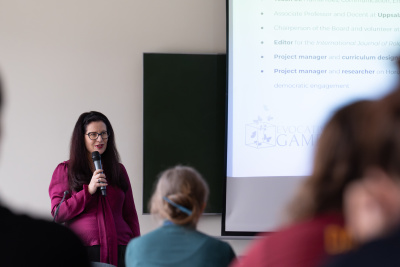
- What do you think about present and future collaboration with the Faculty of Social Sciences and the University of Gdansk? What did you manage to do during quite a short stay - and what are your plans and hopes for the future?
- Well, I've been collaborating with professor Michał Mochocki for quite some time, and we were already planning some grant projects. Kornel Bielawski and I are looking into potentially co-writing. We have a lot of ideas for different kinds of grants that we might go for in the future. It could also be possible that the Faculty of History might use some of my curricular materials that we've been developing in my Erasmus+ EDGE project with my research group for a new Master’s programme. We have a team of people from five different countries working on that, so it's very nice that we have two textbooks and that all the curricular materials will be available. It'd be wonderful if those could be used somewhere else, because we put a lot of work into them and, hopefully, they can support development of curriculum elsewhere. We're also looking into potentially having some staff exchange and student exchange. That's more of a long-term process, though.
- Do you think that such educational methods as role-playing games are the future of education? Can you see now that they are helping students - and maybe teachers as well?
- It's a good question. In general, there's been a trend towards more workshop-based, project-based, embodied experiential learning, and situated learning, so that role-playing is not unusual in the sort of trends in educational science. In fact, role-playing has been in the classroom for decades, in simulation and in education.
- Maybe under other names?
- Yes, exactly. For example, there's Drama in Education, and different kinds of other role-plays. But what we do is inspired by the leisure community, so it has very specific properties that are unique because it developed in its own ecosystem, outside of an educational context. Role-playing itself is sort of a human activity. For example, it's very common for people to do role-playing with language learning: “Okay, you're on the bus now. Try to say hello to the you know person at the bus’.
On the other hand, I think as we're moving into this world of AI, where assessment is really challenging, it's hard to tell whether somebody has even written something, much less if they learned anything from what they're producing. I think that these kinds of embodied experiences - those that are intrinsically motivated - where players feel like they have some sort of influence over their own educational journey, even if it's within the context of this game, that is something we could explore as ways to potentially make the choices that the players make in the game have impact within the class itself, for example.
I think that it'll be more and more important for us to be able to observe whether or not a student is actually learning, is actually engaging, is actually undergoing a process of critical thinking. And this is one of many, but one method that can help with that.
- If someone (for example, an academic teacher) would like to use games in their teaching, what skills should they have or obtain?
- Well, I think that a lot of the skills are transferable. If you're used to holding workshops, for example, then holding a larp (or other kind of role-playing games) is not that different, depending on the game, of course. So, for example, being able to direct the class, to focus attention, to facilitate - these skills seem transferable.
Of course, there are some things that are quite different. Most teachers don't have to count dice and figure out if an action succeeds or fails. They're not usually telling a story that they need to emergently change depending on what the players do. Those are very specific skills that are related to role playing - and so that often can feel very scary for new teachers, especially if they see someone on YouTube that's super good at this. That can be intimidating. Another thing is that some people are used to more lecture format, more structure. They would be ‘the sage on the stage’, as we call it, rather than ‘the guide on the side’ - which is also a totally legitimate way of teaching.
Role-playing games are only one method. The teacher who uses it must accept that there's going to be a certain amount of chaos in the classroom that they just can't control. It's going to be loud. It's going to be hard to tell what's going on, especially if it's a larp. People might be interacting all over the room and you don't exactly know what they're doing. And so, the teacher needs some tolerance for the unpredictable and to be able to adapt to what's happening. For some teachers, if they want to try the method but they're unsure - it might be better to bring in somebody who knows how to do it first and to show them how it works - and then they can gain some skills when co-facilitating. Or they may go to a teacher training that's specifically around role playing so they can gain some confidence with the method. Now, there are others that just try it straight off the bat. I think that's amazing, but I do hear that as a common misgiving, that some people don't know if they can handle that type of classroom environment.
- As you said, it's just one of the methods. I suppose that every teacher has his favourite method that may, in their case, work best. And my last question: What's your favourite role-play game and why?
- Oh boy, that changes! I have my sort of all-time favourites, of course. There's one called “Mage: The Ascension’, which is about being able to affect reality with your mind. To me, it is a lovely metaphor for role-playing in general. It's like: There are a lot of things about reality we can't change, but there are things that we can, especially social reality. The idea that you can, through your paradigm, through your way of thinking, affect the world - I think that's very potent.
I also love this game called “Dream Askew’, which is about a queer enclave in the post-apocalypse. Basically, people have been rejected - even from the surviving society - and they are trying to make it work as a community. It incentivizes cooperation, vulnerability, sharing, and I think those are wonderful. That has been very inspirational for my work, like how do you create game structures that incentivize the kinds of behaviours that are going to help foster community rather than just being a power expression.
I’m not to say there's anything inherently wrong with power - and I think that in these games, even if they seem violent, it doesn't mean the player's violent by any stretch of imagination. It can be a metaphor for something else - for example, therapists may use combat in “Dungeons & Dragons’ to help young girls who've experienced trauma empower themselves. So, it's not just about what's happening during the game that is important.
Games also have what we call procedural rhetoric. This is a term by Ian Bogost, meaning that the procedures of the game have an ideology or a logic or a language behind them. What story are we telling when we're just endlessly killing things? And what other kinds of stories can we tell through the mechanics of the game or the structure of the game? I find that interesting.
- The game is just a game. What is more important, it seems, is what is behind the game.
- Exactly!
- Thank you very much!
Sarah Lynne Bowman, Ph.D. is a scholar, game designer, and event organizer. She is currently a Senior Lecturer for the Department of Game Design at Uppsala University. She is a founding member of the Transformative Play Initiative, which studies role-playing games as vehicles for personal and social change. The author of The Functions of Role-playing Games: How Participants Create Community, Solve Problems, and Explore Identity, Sarah Bowman also serves as a co-editor for the International Journal of Role-Playing (2015-) and Nordic Larp (2015-). She visited the University of Gdansk as part of the UG Visiting Professors Programme 2025/2026.