
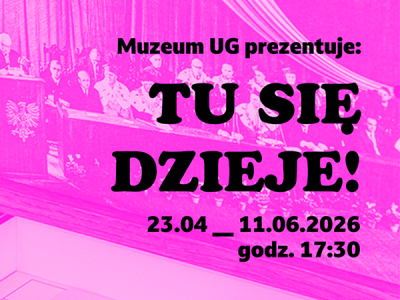
What does quantum physics have to do with the reality we live in? What is everyday life like at the Prof. Krzysztof Skóra Hel Marine Station? How did Gdańskers use to enjoy the flavours of colonial goods - and what can we say about this based on archaeological discoveries? The University of Gdańsk Museum invites you to spring and summer science meetings, inspired by the permanent exhibition! The first meeting is on 23 April this year.
In the cosy lobby of the complex at 5 Bielańska Street, scientists invited by the University of Gdańsk Museum will talk about their work. You can sit in a corner with a cup of coffee and simply listen, but you can also ask questions and discuss with the speaker and the audience.
The idea is simple: everyone should feel at ease at the UG Museum, and any field of science can become the subject of an interesting conversation.
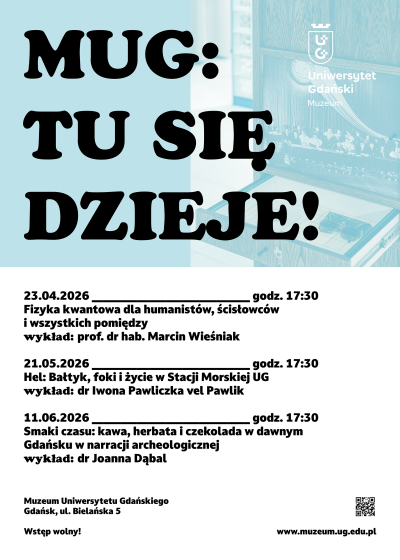
Calendar
23 April 2026 | 5.30 pm
Quantum physics for humanities scholars, scientists and everyone in between
lecture: prof. Marcin Wieśniak, Institute of Theoretical Physics and Astrophysics, University of Gdańsk
21 May 2026 | 5.30 pm
Hel: The Baltic Sea, seals and life at the University of Gdańsk Marine Station
Lecture: dr Iwona Pawliczka (vel Pawlik), Head of the Professor Krzysztof Skóra Marine Station in Hel
11 June 2026 | 17.30
Flavours of time: coffee, tea and chocolate in old Gdańsk through an archaeological narrative
Lecture: dr Joanna Dąbal, Institute of Archaeology, University of Gdańsk
Location:
UG Museum
5 Bielańska Street, Gdańsk
Free admission!
Lecture descriptions
23 April 2026, prof. dr hab. Marcin Wieśniak - ‘Quantum physics for humanities scholars, scientists and everyone in between’
Have you ever felt out of your depth when a conversation in company turned to quantum physics? Does your body tense up and automatically prepare to flee as soon as the topic comes up? Do you feel that the part of your brain responsible for understanding the sciences is completely flat?
That can change!
During the session at MUG, we’ll try to answer the questions that have been puzzling scientists (and others) for years: what exactly is the quantum world, why does it behave so strangely, and what does all this have to do with the reality we live in every day? No scaremongering, just examples, analogies and short thought experiments.
It will be part lecture, part story, and part shared ‘aha!’ moment. You’ll leave feeling that quantum physics is neither magic nor secret knowledge. It’s simply a different, surprising way of describing the world.
21 May 2026, dr Iwona Pawliczka (née Pawlik) - ‘Hel: The Baltic Sea, seals, and life at the University of Gdańsk Marine Station’
If you mainly associate Hel with the beach or the seal sanctuary, then… it’s time to see what really goes on there! Join us for a talk about the University of Gdańsk’s Professor Krzysztof Skóra Marine Station in Hel - a place where the Baltic Sea isn’t just a view from the window, but a daily space for work, research and conservation activities.
We’ll talk about what the Marine Station does on a daily basis: what the work of scientists and animal carers looks like, how field research is conducted, what is studied in the Baltic Sea, and what a typical day is like in a place that combines science with real-world action.
There will also be something for those who like to learn actively: volunteering at the Marine Station. Regardless of your field of study or current job - if you love nature, want to gain new experiences, or simply fancy trying something new, consider joining the station’s team. We’ll tell you how to do it.
Drop by, listen, ask questions and see if Hel isn’t the place for you - for a while or for longer!
11 June 2026, dr Joanna Dąbal - ‘Flavours of Time: coffee, tea and chocolate in old Gdańsk through an archaeological narrative.’
Everyday life today: coffee, tea and chocolate.
Join us for a brief reflection on the material context of colonial flavours in Gdańsk, presented as an interdisciplinary narrative illustrated by archaeological discoveries. We will recall the scenes of the first tastings, the circumstances surrounding the establishment and spread of consumption habits in Gdańsk’s domestic and public spaces.
We will see Gdańsk in various forms and colours, which evoke the tastes of the city’s former inhabitants, revealing the process that led to today’s freedom of choice.